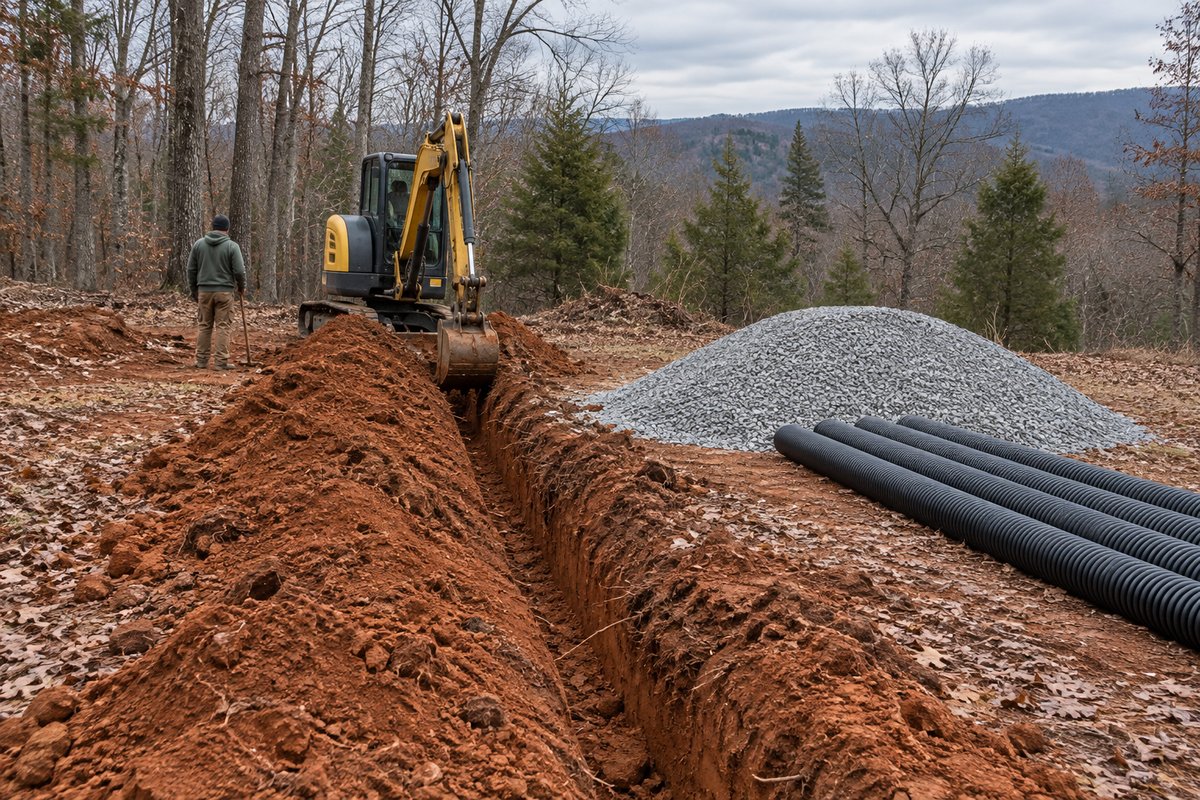
Homeowners and builders in East Tennessee often assume a septic installation has to wait until spring. That is only partly true. In our part of the state, the thing that decides whether a drain field can go in is rarely the thermometer. It is how wet the soil is on the day the machine goes to work, and what the soil evaluation says about how that lot behaves in the wettest months.
Here is how winter weather, soil testing and Tennessee's own septic rules fit together, so you can plan a fall or winter start with realistic expectations.
Winter in East Tennessee is wet more than it is frozen
It helps to look at actual climate records. The National Weather Service keeps long-term records at Crossville, which sits up on the Cumberland Plateau. Its normal January low is about 26 degrees and the normal high is about 44, with an average of 23 days in January where the temperature dips to freezing or below. Normal precipitation is roughly 5 inches in both December and January, in a year that totals more than 57 inches.
Tennessee climatology summaries describe the same pattern statewide: the greatest precipitation comes in winter and spring, and fall is generally the driest time of year. The Cumberland Plateau averages somewhere between 52 and 60 inches of precipitation a year, while the Great Valley around Knoxville and Loudon is drier, from about 40 inches in the northern end to more than 55 in the south.
What that means on a job site is simple. Freezing mornings are common, but daytime thaws are too, and the ground spends much of the winter saturated rather than solid. Wet soil is the bigger scheduling issue for a septic system.
Why wet soil matters so much for a drain field
A septic drain field works because wastewater soaks into undisturbed soil with its natural pore structure intact. Heavy equipment working on soil that is too wet squeezes those pores shut (compaction) or smooths the trench walls into a sealed surface (smearing). The University of Minnesota's onsite sewage program puts it plainly: soils that are saturated or nearly saturated have lower strength and compact and smear more than the same soil when dry, and the higher the clay content, the greater the risk. East Tennessee has plenty of clay-rich ground, so this is not an abstract concern here.
Tennessee's rules say the same thing in regulatory language:
- For conventional drain fields, trenches shall not be excavated when the soil is wet enough to smear or compact easily.
- For alternative systems such as mounds, no site preparation is to occur if the soil is wet, and the person responsible for monitoring the installation determines when the soil is adequately dry.
- The soil area reserved for the initial and duplicate (reserve) fields must not be cut, filled, compacted or disturbed in any manner before or after installation.
So a good winter install schedule is not a calendar date. It is a string of workable days. A contractor who tells you the work will go in "whenever the soil is ready" is giving you the correct answer, even if it is less satisfying than a firm date.
Frozen ground is a different problem
Frost behaves differently from mud. The same University of Minnesota guidance notes that soil should not be frozen at the surface where wastewater will be absorbed, because smearing can occur under those conditions as well. On the Plateau, hard overnight freezes are common in winter, but daytime highs in the 40s are normal for January. Mild stretches between freezes can still be workable. A deep cold snap, or a freeze that follows a soaking rain, is when a job should pause.
If a system is installed late in the year before grass has time to establish, the same university program recommends a thick layer of loose mulch such as straw over the pipes, tank and soil treatment area for added insulation and cover, to be raked off in spring so vegetation can grow. Ask your installer what ground cover plan they will use on a late-season job.
Winter is actually a useful time for the soil evaluation
This is the part many people miss. Tennessee's rules say that when borings are needed to find perched groundwater or the water table, they are to be made during the wettest part of the year, at a time approved by the state. The water table is expected to be at least four feet below the bottom of the disposal field, and rock formations are expected to be deeper than four feet below the bottom of the trenches, though a lesser depth can be allowed where soil conditions warrant it.
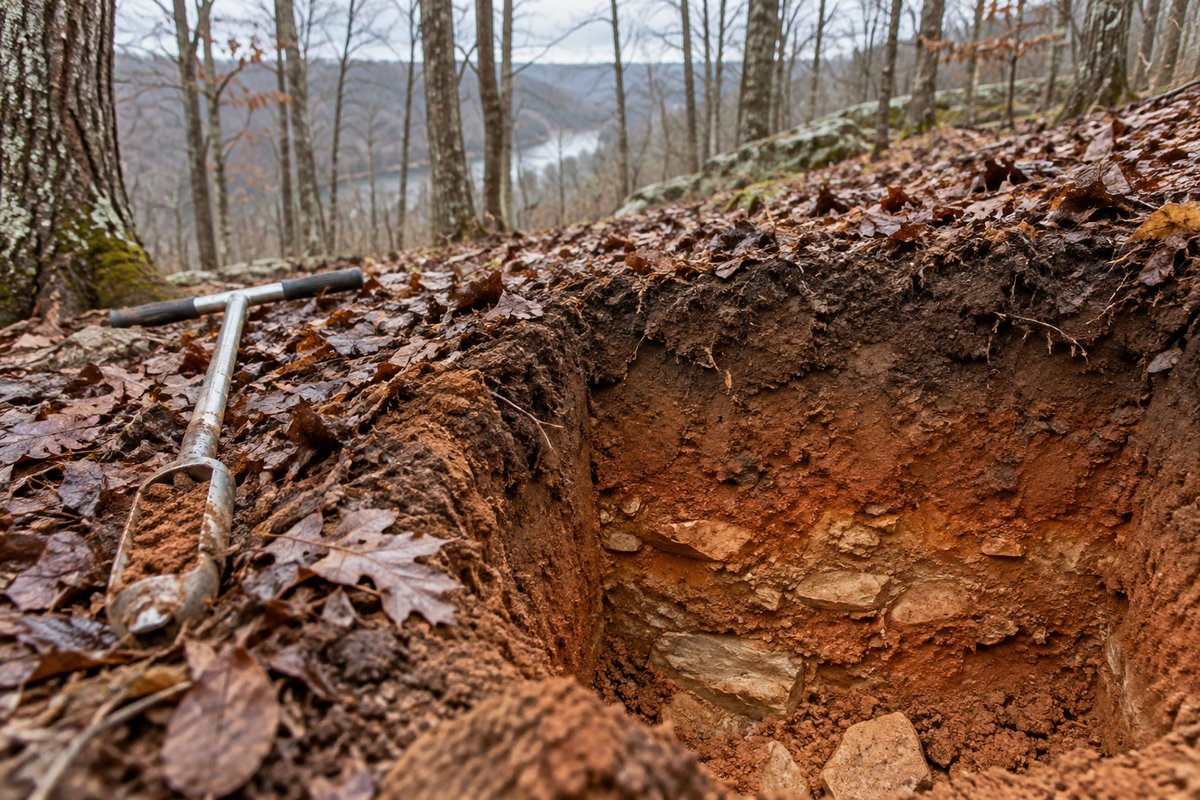
A lot that looks dry and promising in September can show a seasonal high water table in February. Evaluating the ground when it is at its wettest tells you the truth about the site, and it can save you from building a field that works for three months of the year. If you are planning a spring build, getting the soil evaluation done now, while conditions are wet, can be a head start rather than a delay.
Plateau lots and valley lots need different expectations
The National Park Service describes the Cumberland Plateau as rugged terrain with abundant rainfall and soils that are typically thin. On the Plateau side of our service area, including Morgan County, thin soil over sandstone is exactly the kind of condition that can rule out a conventional drain field and bring alternative designs into the conversation, and winter wetness is one more factor to weigh when the system type is chosen. In the valley counties, deeper clay soils bring their own concerns about slow drainage and smearing. Either way, the soil evaluation and the permit decide what can be built, not the season.
How to get your winter project ready
- Stake the house and lot. The state's permit application asks whether the house and lot are staked, and a reviewer cannot judge where the system fits without it.
- Settle the bedroom count. Tennessee sizes systems by bedrooms, and the application asks for the number of bedrooms and occupants.
- Protect the field area. Keep trucks, builders and stockpiles off the reserved area from day one.
- Plan the permit time. The state says review of a septic construction permit application generally takes about 10 days and must be completed within 45 days of submission. Counties such as Knox, Blount and Sevier are contract counties and may require an additional permit.
- Sequence the site work. Clearing, rough grading and the septic system should be scheduled together so the field area is never rutted by other trades.
Frequently Asked Questions
Can a septic system be installed in winter in East Tennessee?
Often, yes, on workable days. The limiting factors are soil that is too wet to excavate without smearing or compacting, and frozen ground at the surface where the system will absorb water. Mild stretches between storms can be perfectly good installation windows.
Do I have to wait for spring to get a permit?
No. The permit process does not stop in winter, and a soil evaluation done in the wet season is useful because the water table is at its highest. Ask your local permitting office or an approved soil consultant what they need for your lot.
Will rain delay my installation?
It can. After a heavy rain the soil may need days to dry enough to work without smearing, and on a clay lot or a hillside with seeps that can take longer. Building some flexibility into your schedule is wise.
Is a winter-installed system worse than one installed in summer?
Not when it is built in suitable soil conditions to the permitted design and inspected. A system built in muddy conditions is the one that can have trouble later, whatever the month.
Planning a septic project this winter?
We install conventional, pump and alternative septic systems across Loudon, Roane, Knox, Anderson, Morgan, Monroe, Blount, McMinn, Meigs and Sevier counties, and we coordinate the soil evaluation, permit and inspection steps. If you would like to talk through timing for your lot, contact us through the Clear Flow contact page and request a quote.