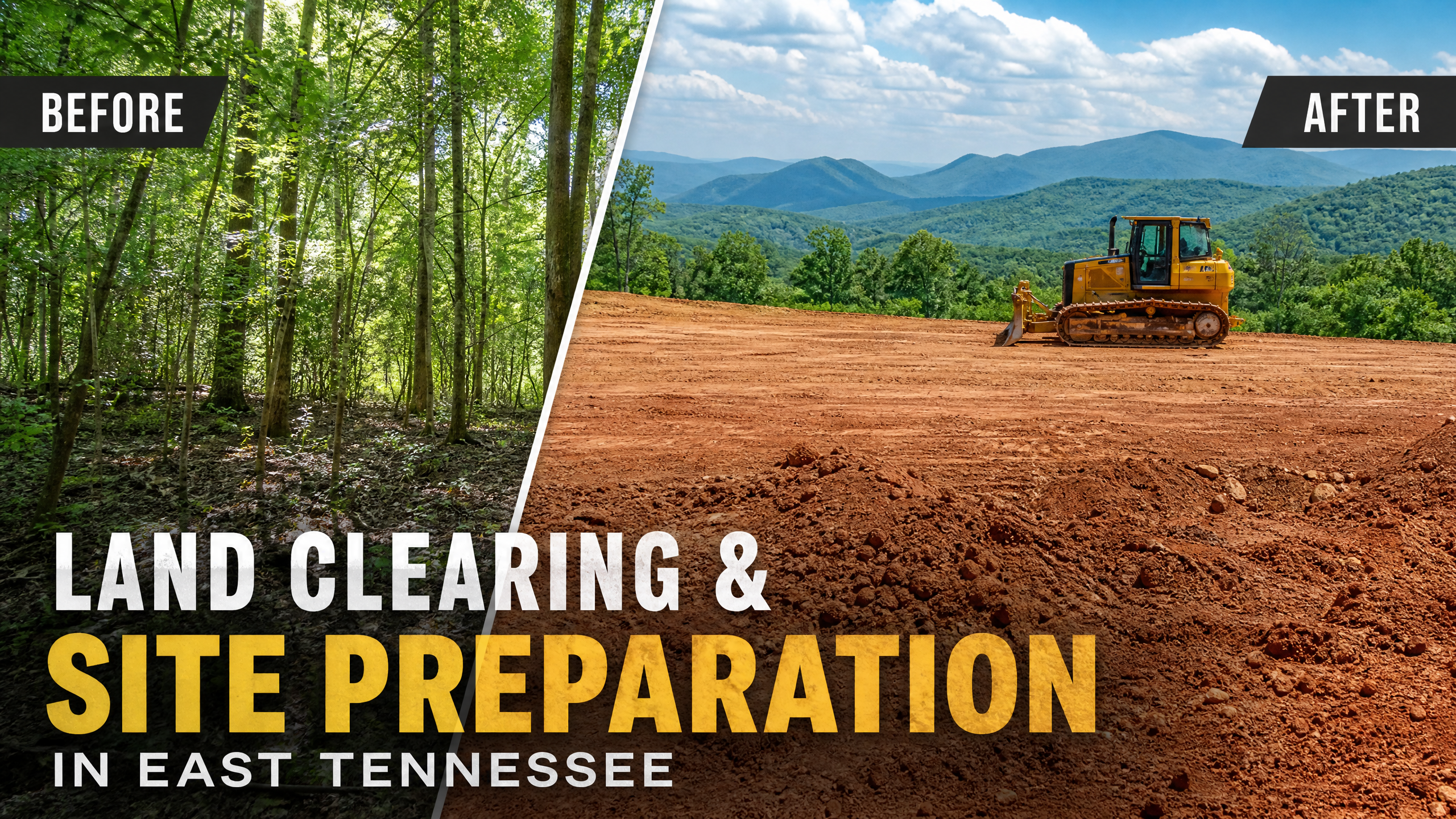
You've purchased your lot in East Tennessee. You've got your building plans drawn up and you're ready to break ground. But before your builder can pour a foundation, the land needs to be cleared and prepared. For many first-time home builders, the land clearing and site prep process is unfamiliar territory, and that's where Clear Flow Services comes in.
In this guide, we'll walk you through the complete land clearing and site preparation process for new home construction in East Tennessee, from the initial site evaluation through the final graded and ready-to-build lot.
Step 1: Site Evaluation
Before any equipment rolls onto your lot, we conduct a thorough site evaluation. This includes:
- Reviewing your survey and building plans, We need to know where the house will sit, where the driveway will go, and where the septic system will be located (if applicable).
- Assessing tree density and species, The type and density of trees on your lot affects the clearing timeline and cost.
- Evaluating terrain and drainage, We assess the natural drainage patterns on your lot and identify any potential drainage challenges.
- Identifying trees to save, If you want to preserve specific trees, we mark them before clearing begins.
- Locating underground utilities, We call 811 (Tennessee One Call) to have all underground utilities located and marked before any digging begins.
Step 2: Permits and Approvals
Depending on your county and project scope, you may need permits before land clearing can begin. In Tennessee, land disturbance over certain acreage thresholds may require an erosion control permit. Clear Flow will advise you on permit requirements for your specific project and county.
If your project includes a septic system, we also begin the TDEC permit process at this stage. Septic permits typically take 2–4 weeks to approve, so starting the process early keeps your project on schedule.
Step 3: Tree Removal and Brush Clearing
The clearing phase begins with removing trees and brush from the building area, driveway corridor, and septic system location. Our excavator makes quick work of most residential lots.
East Tennessee's forests are predominantly hardwood, oaks, hickories, maples, and tulip poplars, with some pines and cedars mixed in. Hardwoods are heavier and more difficult to process than softwoods, which is why clearing costs in East Tennessee can be higher than in regions with lighter timber.
During the clearing phase, we sort materials where possible:
- Large logs can be left on-site for your use (firewood, lumber) or hauled away
- Brush and small-diameter material can be chipped on-site or hauled to a disposal facility
- Stumps are ground below grade or fully excavated, depending on your preference and the construction requirements
Step 4: Stump Removal
Stump removal is a critical step that's sometimes overlooked. Stumps left in the ground will decompose over time, causing the soil above them to settle and creating voids that can compromise your foundation, driveway, or yard. For building areas, we always remove stumps completely. For areas that won't be built on, grinding stumps below grade is typically sufficient.
Step 5: Rough Grading
With the trees and stumps removed, we begin rough grading, the initial earthmoving that establishes the general elevation and drainage patterns for your lot. Rough grading involves:
- Cutting high spots and filling low spots to create a more level building area
- Establishing positive drainage away from the building site
- Creating the rough shape of the driveway corridor
- Moving topsoil to the side for later use in finish grading
East Tennessee's clay-heavy soils require particular attention during rough grading. Clay expands when wet and contracts when dry, which can cause significant movement in improperly graded sites. We grade every site with these soil characteristics in mind, ensuring proper drainage and compaction.
Step 6: House Pad Construction
The house pad is the level, compacted area on which your home's foundation will be built. Constructing a proper house pad involves:
- Excavation, Removing soil to the required depth for your foundation type
- Subgrade preparation, Removing organic material and soft spots from the subgrade
- Fill placement and compaction, Adding and compacting fill material in lifts to achieve the required density
- Final grading, Precision grading to achieve the exact elevation specified in your building plans
The house pad must be graded to the exact elevation specified by your builder or engineer. We work closely with your builder to ensure the pad meets their specifications before they begin foundation work.
Ready to Clear Your Lot?
Get a free on-site evaluation and quote from Clear Flow.
Step 7: Driveway Grading
The driveway corridor is graded and compacted to provide a stable base for your gravel or paved driveway. Proper driveway grading ensures adequate drainage, water should drain off the driveway surface, not pool on it. We grade driveways with a slight crown or cross-slope to ensure proper drainage.
Step 8: Erosion Control
Freshly cleared and graded land is highly susceptible to erosion, particularly during Tennessee's frequent rain events. Clear Flow installs erosion control measures, silt fences, straw wattles, and temporary seeding, to protect your lot from erosion during construction. These measures are also required by Tennessee's erosion control regulations for disturbed areas above certain size thresholds.
Step 9: Utility Trenching
With the site graded, we typically trench for utilities, sewer lines, water supply lines, and underground electric conduit, before the builder begins foundation work. Coordinating utility trenching with site prep is more efficient than bringing equipment back to the site multiple times.
Step 10: Septic System Installation
If your lot requires a septic system, installation typically happens after the house pad is complete and before the builder begins framing. Clear Flow coordinates the septic installation with the overall construction schedule to minimize delays.
How Long Does the Process Take?
The timeline for land clearing and site prep depends on lot size, terrain complexity, and weather. A typical residential lot (1–2 acres) can be cleared and graded in 3–7 days. Larger lots or more complex terrain take longer. The septic permit process adds 2–4 weeks to the overall timeline, which is why we recommend starting the permit process as early as possible.
What Does Land Clearing and Site Prep Cost in East Tennessee?
Land clearing and site prep costs vary based on lot size, tree density, terrain, and the scope of work required. A basic clearing and grading package for a residential lot typically starts at $5,000–$10,000. Adding a house pad, septic installation, and utility trenching increases the total cost. Clear Flow provides free on-site quotes for all projects.
The most cost-effective approach is to hire a single contractor to handle the complete site work package, clearing, grading, house pad, septic, and utility lines. This eliminates coordination costs and scheduling delays between multiple contractors.
Clear Flow Services, LLC
Loudon, TN · 865-413-8790
Serving East Tennessee since 2022